

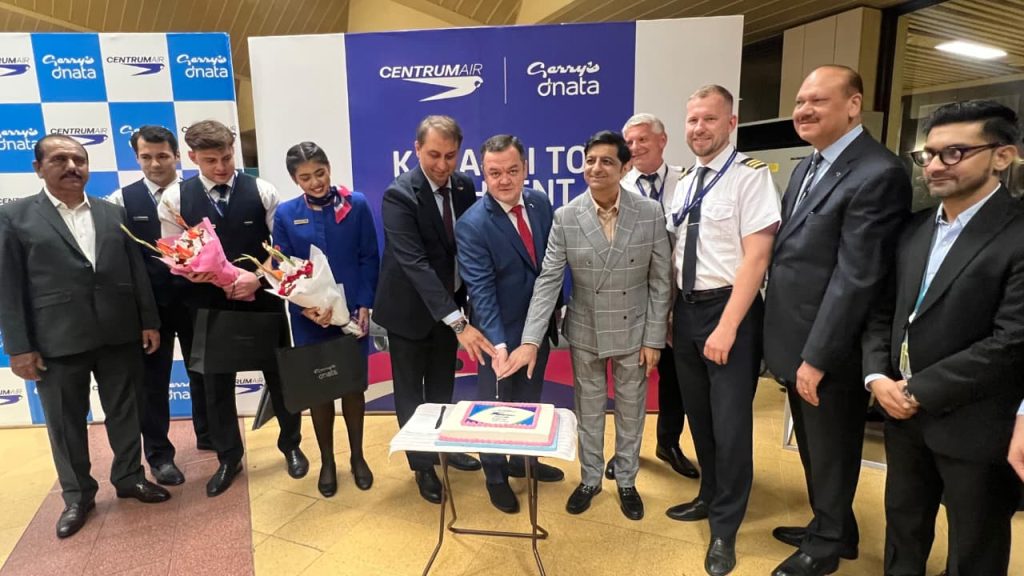
Centrum Air has officially launched direct, non-stop flights between Karachi and Tashkent, with the inaugural flight departing Jinnah International Airport on September 3. The launch was marked by an inauguration ceremony hosted by Gerry’s dnata, bringing together representatives from Gerry’s Group, Centrum Air, and the Embassy of Uzbekistan.
Ceremony Details
The event was attended by Alisher Tukhtaev, Ambassador of the Republic of Uzbekistan; Arshad Wali Muhammad, Group Director, Gerry’s Group; Adilmirza Khalmirzaev, Head of Agents Relations Department, Centrum Air; and Ken Marshal, Chief Operating Officer, Gerry’s International, alongside other aviation industry representatives. The inauguration featured a traditional water cannon salute, followed by ceremonial celebrations with dignitaries, cockpit crew, and operational teams.
Route Details
The Karachi–Tashkent route will operate two direct, non-stop flights per week, giving passengers a new option for travel between Pakistan and Uzbekistan.
This Route Is Part of a Larger Connectivity Push
Karachi–Tashkent isn’t an isolated launch — it’s one piece of a rapidly expanding air corridor between the two countries. According to Uzbekistan’s ambassador to Pakistan, direct flights didn’t exist at all just two years ago; today, regular passenger and cargo services already connect Tashkent with Islamabad and Lahore, and with Karachi now added, weekly flight frequency between the two countries is expected to reach nine flights a week by October 2026.
That expansion is being driven by a broader economic push: Pakistan and Uzbekistan have set a target of $2 billion in bilateral trade by 2029, up from roughly $400–450 million in 2024–2025, with both governments actively working through a revived Joint Ministerial Commission, an expanded Preferential Trade Agreement, and discussions around a proposed Uzbekistan-Afghanistan-Pakistan railway to strengthen overland connectivity as well.
Why This Matters for the Trade
For Karachi-based agencies, this route fills a real gap — until now, Tashkent connectivity from Pakistan ran through Islamabad and Lahore only. With trade officials explicitly linking rising flight frequency to a five-year trade and investment roadmap between the two countries, agencies working with Central Asian itineraries, business travel, or Uzbek trade delegations now have a direct Karachi option rather than routing through Pakistan’s northern cities.
The launch reflects growing momentum in Pakistan-Uzbekistan aviation and commercial ties, expected to support greater business, tourism, trade, and cultural exchange while strengthening Pakistan’s connectivity with the wider Central Asian region.